
Voice AI · October 2, 2026 · 7 min read
AI Receptionist for Medical and Dental Practices in South Africa
Most practice phones ring hardest at the worst moments: 07:45 before the first patient, over lunch, and straight after closing. The person at the front desk is checking in a patient, taking a medical aid number and answering the phone at the same time, and something gives. Usually it's the phone.
An AI receptionist can take the routine calls off that desk. But a medical or dental practice is not a plumbing business. Callers are anxious, some calls are urgent, and almost everything they say is health information. This guide covers where an AI receptionist fits in a South African practice, where it must stop, and what POPIA expects of you.
What Can an AI Receptionist Do for a Medical Practice?
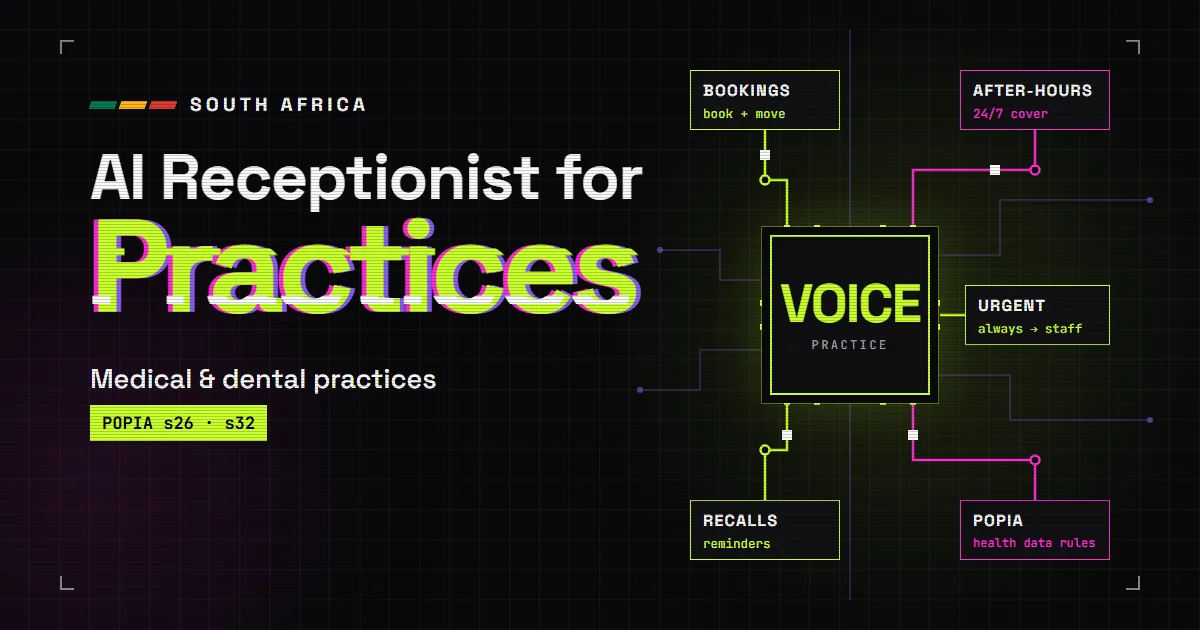
An AI receptionist for a South African medical or dental practice answers calls 24/7, books, moves and cancels appointments, answers practical questions (hours, location, parking, which medical aids the practice accepts), sends reminders, and passes anything clinical or urgent to a person. It must never give medical advice or decide how urgent a symptom is. Because patient calls contain health information, which POPIA classes as special personal information, the practice needs a written operator agreement with the provider and a script that collects only what the booking needs. Costs start from around R500/month, and setup takes 10–14 days.
What It Handles Well in a Practice
The calls an AI receptionist suits are the ones your front desk could answer half-asleep. In most practices that is the majority of the phone traffic.
- Bookings and changes: new appointments, reschedules and cancellations, including the ones that come in at 21:00
- Practical questions: hours, address, parking, whether the practice is in network for a medical aid, what to bring to a first visit
- After-hours cover: callers get a real answer and a booking instead of voicemail, and urgent calls get pointed to the right number straight away
- Reminders and recalls: appointment reminders, six-monthly dental recalls, and follow-up booking prompts
- Overflow: when reception is busy with a patient at the desk, the AI picks up instead of letting the line ring out
What It Must Never Do
This is the part to settle before anything goes live, and the practitioner signs it off, not the provider.
- Give medical or dental advice of any kind, including "it is probably nothing"
- Decide how urgent a symptom is. Anything that sounds urgent is passed to a person, every time
- Discuss results, diagnoses or anything from the patient file
- Handle an emergency itself. The script tells the caller to hang up and call 10177 (ambulance) or 112 from a cellphone, then alerts the practice
- Confirm to a third party that someone is a patient
POPIA and Patient Calls: What Applies
Under POPIA, health information is special personal information (section 26), which is prohibited from processing by default. Section 32 lifts that prohibition for medical professionals and healthcare institutions where the processing is needed for treatment and care or for running the practice, as long as there is an obligation of confidentiality. Taking a booking call falls inside that.
What changes with an AI receptionist is that a third party now handles the call. In POPIA terms that provider is an operator, and section 21 requires a written contract that obliges it to keep the information secure. The HPCSA's confidentiality guidance (Booklet 5) also makes practitioners responsible for making sure receptionists and other staff respect confidentiality. Our reading is that the same standard applies to a system answering on the practice's behalf. This is general guidance, not legal advice. Check your own position with your professional body or attorney.
- Operator agreement: signed before go-live, covering security, where the data is stored, and deletion
- Collect the minimum: name, contact number, and the type of appointment. Not a description of symptoms
- Tell callers: the greeting says calls are answered by an automated assistant and may be recorded
- Retention: set how long recordings and transcripts are kept, and delete on schedule
How Setup Works for a Practice
The 10–14 day setup is the same as for any business, with two extra steps: the escalation rules, and how bookings get into your diary.
- Call review: a week of real call types, sorted into "AI can answer", "AI books, human confirms" and "always a human"
- Escalation rules: written with the practitioner and tested with role-played urgent calls before launch
- Diary connection: depends on your practice management software. Where it can't be connected, the AI captures the booking request and sends it to reception to confirm, which still takes the call off the desk
- Same number: patients keep calling the number they already have
What It Costs
DB23 Voice AI starts from around R500/month for a single-practitioner practice with moderate call volume, and rises with call volume and diary integration. For the full cost breakdown and how it compares with a human receptionist, see AI receptionist costs in South Africa and AI vs human receptionist.
Most practices don't replace their receptionist. They use the AI for after-hours, lunch and overflow, so the person at the desk can deal with the patient in front of them.
Frequently Asked Questions
Tags: AI Receptionist · Medical Practices · POPIA
